
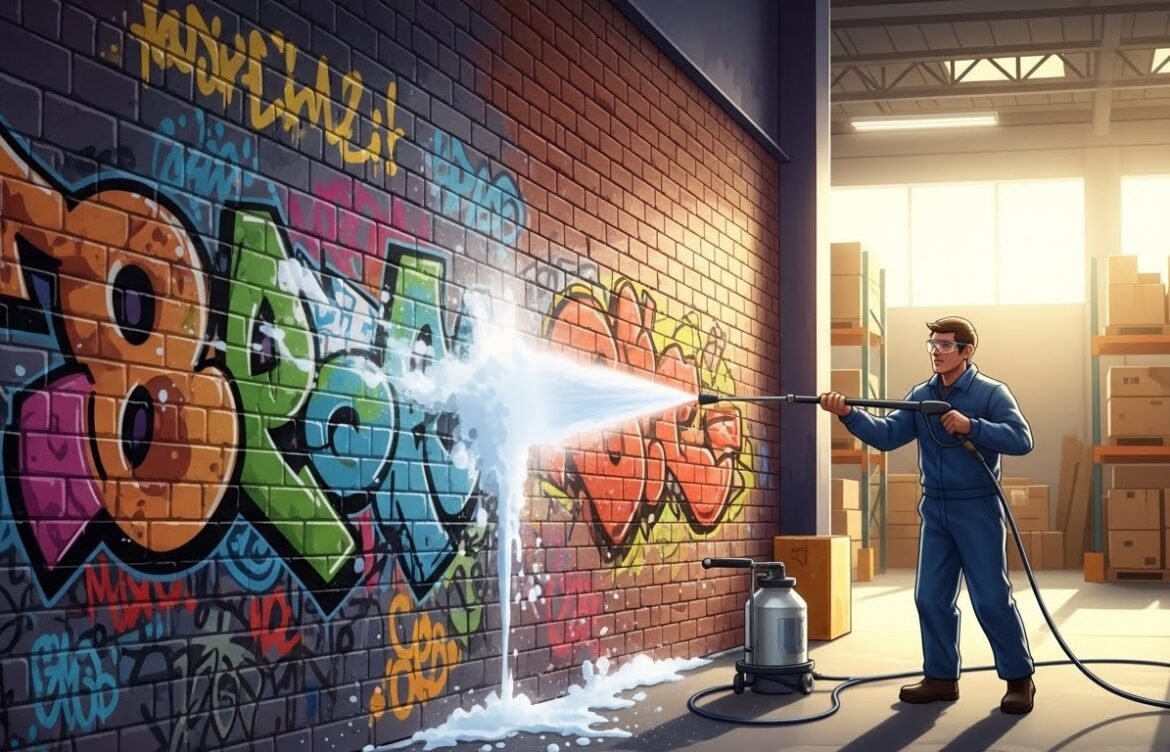
Anti-Graffiti Coatings for Warehouses Why You Need Specialized Pros
You know that sinking feeling.
You drive up to your facility on a Monday morning, coffee in hand, ready to tackle the week. You turn the corner into the loading dock area, and there it is. Giant, jagged spray paint across your back wall.
It wasn’t there Friday. Now, it’s the first thing your delivery drivers, your clients, and your neighbors see.
It feels like a violation. And honestly? It’s a massive headache.
Your first instinct might be to grab a bucket of leftover paint and a roller to just cover it up. I get it. You want it gone, fast. But here is the hard truth about warehouse walls—especially concrete, brick, or metal ones: simply painting over graffiti usually makes it look worse. You get that weird mismatched square of fresh paint, or worse, the spray paint bleeds right through the new coat a week later (we call that “ghosting,” and it is incredibly frustrating).
This is why commercial painting isn’t just about color; it’s about protection. Specifically, anti-graffiti coatings.
At Precision Paint Experts, we’ve seen business owners try to battle taggers with standard exterior paint, and they almost always lose. To actually win this battle, you need a strategy, not just a brush.
Here are the 5 critical things specialized commercial contractors bring to the table that a general painter (or your maintenance guy) might miss.
1. Understanding the “Sacrificial” vs. “Permanent” Choice
Did you know there are two completely different ways to protect your building from spray paint? Most people don’t. They just ask for “anti-graffiti paint.”
But using the wrong one can cost you a fortune later.
The Deep Dive:
A professional contractor will assess your wall surface and your risk level to recommend either a Sacrificial Coating or a Permanent (Non-Sacrificial) Coating.
- Sacrificial Coatings: Think of this like a clear wax layer on your wall. When someone tags it, you use a pressure washer to melt the wax away, taking the graffiti with it. You then have to re-apply the coating. It’s cheaper upfront and great for natural stone.
- Permanent Coatings: This is a hard-shell armor. It creates a surface so slick that spray paint can’t bond to it. When tagged, you just wipe it off with a solvent, and the coating stays put.
Real-World Scenario:
We worked with a distribution center that had a beautiful brick façade. They were getting tagged weekly. A permanent coating would have made the brick look shiny and plastic (which they hated). We applied a sacrificial coating that was invisible. The next time they got tagged, our pressure washing team cleaned it off in twenty minutes without harming the brick.
Pro Tip:
If your building is heritage brick or stone, never use a permanent coating without testing. It can trap moisture and ruin the masonry.
2. The “Ghosting” Problem (And How to Kill It)
I mentioned this earlier, but it deserves its own section because it is the number one complaint we hear.
You paint over the tag. It looks clean. Three days later, a faint shadow of the tag starts appearing through the new paint.
The Deep Dive:
Spray paint is aggressive. It has solvents that bite deep into porous surfaces. Standard latex exterior paint sits on top. The solvents in the spray paint can migrate through the latex.
Specialized commercial painters don’t just paint; they seal. We use industrial-grade stain-blocking primers that lock those pigments down before applying the topcoat.
Real-World Scenario:
A warehouse manager in an industrial park tried to cover black spray paint with white standard exterior paint. He put four coats on it. You could still see the tag. He wasted hundreds of dollars in paint and labor. We came in, spot-primed with a shellac-based blocker, and covered it in one coat. Done.
3. Reach and Access (Safety First, Seriously)
Warehouses are tall. Like, really tall.
Your maintenance team might have a 12-foot ladder. But that tag is usually right at the roofline because taggers love high-visibility spots.
The Deep Dive:
Hiring a “Chuck in a Truck” residential painter for a 30-foot tilt-wall warehouse is a liability nightmare. Commercial contractors come with boom lifts, scissor lifts, and—crucially—the insurance to operate them.
Expert Insight:
At Precision Paint Experts, safety isn’t just a clipboard checklist. It’s about ensuring that while we are fixing your wall, we aren’t disrupting your loading docks. We know how to coordinate with your logistics manager so we aren’t parking a lift in front of Bay 3 when a semi is due in five minutes.
For large-scale projects, check out our approach to commercial painting where logistics are just as important as the paint.
4. Surface Prep is 90% of the Battle
You cannot apply an anti-graffiti coating over a dirty wall. It won’t stick.
And let’s be honest, warehouse exteriors get filthy. Diesel exhaust, road dust, mildew—it all creates a film on the building.
The Deep Dive:
If you apply a clear anti-graffiti coat over a dirty wall, you have just permanently sealed that dirt onto your building. It will look muddy forever.
We perform a heavy-duty chemical clean and pressure wash before any coating goes on. This ensures the bond is tight and the building looks fresh under the protective layer.
Quick Tip:
If your facility has metal siding, prep is even more critical. Metal expands and contracts in the heat. If the coating isn’t flexible and bonded correctly, it will crack. (See more about our exterior painting process here).
5. Maintenance Plans (Set It and Forget It)
The best defense is speed.
Taggers want fame. They want their “work” to be seen. If you remove their tag within 24 hours, you take away their reward. They usually move on to a building that leaves the tags up.
The Deep Dive:
A good commercial contractor won’t just do the job and vanish. They offer maintenance retainers. This means when you get tagged, you don’t have to scramble for quotes and approvals. You make one call, and a crew is dispatched to clean it (if you have the coating) or block it out.
Comparison: General Painter vs. Specialized Commercial Contractor
It helps to see why the specialized route is worth it for commercial properties.
| Feature | General Residential Painter | Commercial Specialist (Precision Paint Experts) |
| Product Knowledge | Standard Latex/Acrylic | Epoxies, Urethanes, Siloxanes (Anti-Graffiti) |
| Equipment | Ladders & Rollers | Boom Lifts & Airless Sprayers |
| Graffiti Strategy | “Just paint over it” | Removal, Barrier Coatings, & Stain Blocking |
| Scheduling | 9-to-5 | Nights/Weekends to avoid shutting down operations |
| Liability | Standard | Heavy Commercial Coverage |
Key Takeaways
- Don’t just paint over it. Without the right primer, the graffiti will bleed back through (“ghosting”).
- Choose your armor. Decide between Sacrificial (easy removal, must re-apply) or Permanent (wipe-clean, higher upfront cost).
- Speed kills tagging. The faster you remove it, the less likely they are to come back.
- Safety matters. High warehouse walls require lifts and certified operators, not ladders.
- Prep is vital. Never seal a dirty wall.
Conclusion & Next Steps
Your warehouse is a massive asset. It’s the face of your logistics and operations. You shouldn’t have to let vandalism dictate how your business looks.
It’s annoying to deal with, I know. But with the right protective coating, graffiti stops being a crisis and becomes just a minor inconvenience that wipes away.
If you’re tired of playing cat-and-mouse with taggers, or if you just want to freshen up your facility’s exterior, let’s talk. We can assess your surfaces and figure out which coating fits your budget and your building.