
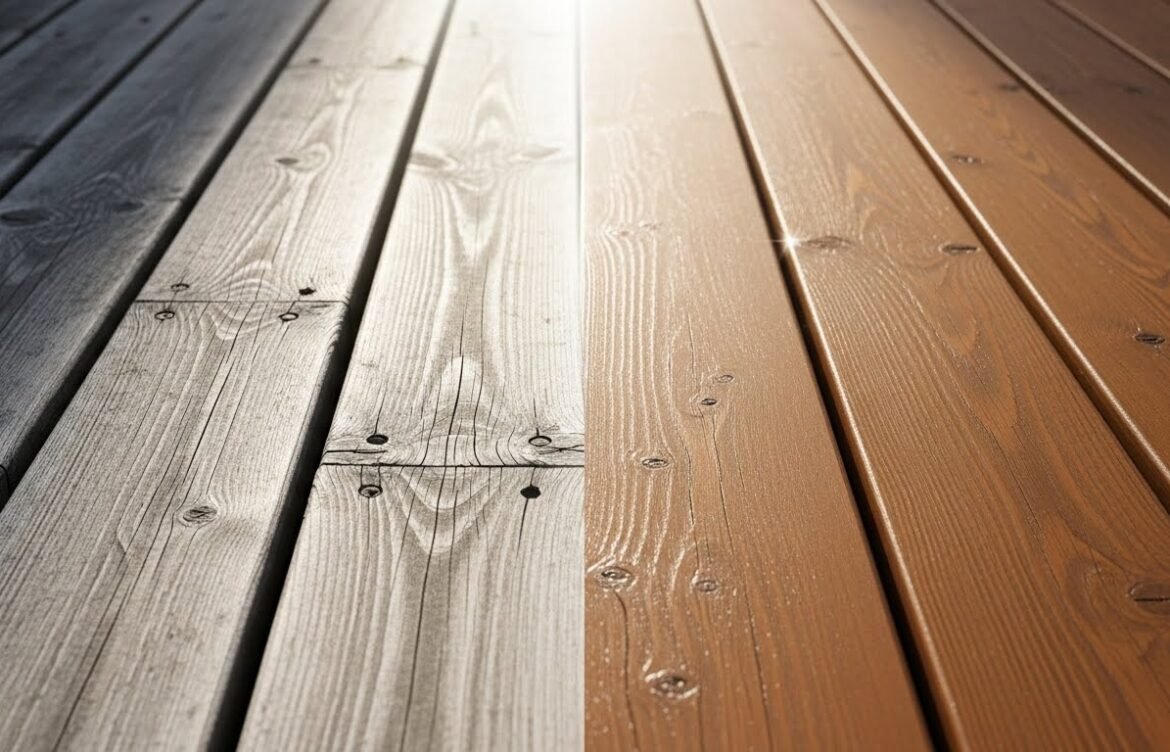
Why Decks Turn Gray (And How a UV Protection Warranty Stops It)
You know that feeling when you first install a new cedar fence or build a pressure-treated deck? The wood has that warm, golden honey color. It smells amazing. It looks like it belongs on a magazine cover.
And then… six months go by. Maybe a year.
You walk into your backyard with your morning coffee, look down, and realize the gold is gone. It’s been replaced by a dull, lifeless gray. Or worse, you see the stain you spent a scorching July weekend applying starting to flake off in big, ugly chips.
It’s frustrating. It feels like you wasted your money. And honestly? You kind of did.
I see this happen constantly. Homeowners try to do the right thing. They buy a bucket of “waterproofer” from the big box store, slap it on, and hope for the best. But they’re fighting an invisible enemy they don’t fully understand: The Sun.
At Precision Paint Experts, we treat wood restoration less like painting and more like dermatology. It’s about sunblock. It’s about hydration. And it’s about using products that come with a real warranty, not just a promise on a label.
Here are the 5 things you need to know about professional staining and why a UV protection warranty is the only thing that matters for your wood’s lifespan.
1. Wood Gets “Sunburn” (Just Like You)
We worry a lot about rain rotting our decks. And sure, water is bad. But the sun is actually the first assassin.
Here’s the science-y part, simplified: Wood fibers are held together by a natural glue called lignin. Ultraviolet (UV) rays from the sun bombard your deck all day long. These rays break down the lignin.
When the lignin fails, the wood fibers detach and turn gray. That “gray” layer is actually dead, detached wood cells.
The Expert Insight:
If you apply a stain over gray, sun-damaged wood, it’s like putting duct tape on dust. It won’t stick. A professional job must involve removing that dead layer first to get to the fresh, bondable wood underneath.
2. “Clear” Sealers Are a Trap
I hate to be the bearer of bad news, but if you love the look of raw, natural wood and want to use a crystal-clear sealer… you are signing up for a lot of work.
Clear sealers have zero pigment. Pigment is what blocks UV rays. Think of it like this: Pigment is the zinc oxide in your sunscreen. Without it, the sun goes right through the sealer and cooks the wood underneath. The sealer eventually fails because the wood it’s holding onto disintegrates.
The Better Way:
We always recommend a semi-transparent stain for deck and fence staining. It adds just enough pigment to act as a UV shield, but it’s sheer enough to let the beautiful wood grain show through. It’s the perfect middle ground between protection and aesthetics.
3. The “Bead Up” Test is Misleading
You’ve seen the commercials. Someone pours water on a deck, and it beads up like mercury. “Look! It’s protected!”
Well, maybe.
Water beading just means there is a high surface tension, usually from wax or silicone in the product. But wax sits on the surface. It wears off quickly with foot traffic.
The Expert Insight:
Real protection comes from deep-penetrating oils, not surface waxes. We use industrial-grade stains that dive deep into the wood pores to displace water from the inside out. This prevents warping and cupping, which are structural issues, not just cosmetic ones.
4. Why the Warranty Matters (Read the Fine Print)
This is where things get tricky. You might see a can of stain at the hardware store that says “4-Year Warranty.”
But if you read the back, that warranty usually covers the product, not the labor. And it definitely doesn’t cover “application error.” If it peels, they’ll send you a coupon for another free gallon of the same stuff that failed. Thanks, but no thanks.
The Precision Paint Experts Difference:
When we talk about a warranty, we’re talking about a performance guarantee. Because we are wood staining and finishing specialists, we know our prep process works.
If a contractor won’t stand behind their stain job for at least a couple of years, they know something you don’t—usually that they skipped the pH balancing step (more on that in a second).
5. The Prep Step Everyone Skips: pH Balancing
You can buy the most expensive stain on earth, but if the chemistry of the wood is wrong, it will fail.
Most people know they need to clean the deck. But many cleaners (especially bleach-based ones) leave the wood highly alkaline (high pH). If you slap an oil-based stain on alkaline wood, the oil breaks down prematurely.
The Pro Process:
- Strip/Clean: Remove old stain and dead gray fibers.
- Brighten/Neutralize: This is the secret sauce. We apply an acidic wood brightener. This opens the wood pores and brings the pH back to neutral.
- Dry: We wait until the moisture content is below 15%.
- Stain: Then we stain.
If you skip step 2, you’re gambling.
Comparison: DIY Store-Bought vs. Professional System
It helps to see why the costs and results are so different.
| Feature | Big Box “All-in-One” Stain | Professional Penetrating System |
| Main Ingredient | Film-forming acrylics (essentially paint) | Penetrating oils and paraffins |
| Failure Mode | Peels and flakes (requires sanding to fix) | Fades gracefully (easy to recoat) |
| UV Protection | Low (surface level only) | High (deep tissue protection) |
| Prep Required | “Wash and go” (risky) | Chemical strip & pH balance |
| Lifespan | 12-18 Months | 3-5 Years (Horizontal surfaces) |
Key Takeaways
- Gray is Decay: That silver color is actually dead wood fibers. It has to be removed before staining.
- Pigment is Protection: Clear sealers offer almost zero UV protection. You need some color to block the sun.
- Oil over Acrylic: Film-forming stains (acrylics) peel. Penetrating oils fade. You always want a stain that fades, because you can just clean and recoat it later without sanding.
- Chemistry Class: If you don’t neutralize the wood’s pH after cleaning, the stain won’t bond.
- Trust the Warranty: A warranty is proof that the contractor is confident in their prep work.
Conclusion
Your deck is an extension of your living room. It’s where you grill burgers, host birthday parties, and watch the sunset. It shouldn’t be a source of stress or a collection of splinters.
By using a high-quality, UV-blocking stain system, you aren’t just making it look pretty for this summer. You’re buying years of life for the lumber itself.
If your fence is looking tired or your deck has turned that ghostly gray, don’t rush out to rent a sander just yet. Let’s take a look at it. We can assess the wood’s condition and prescribe the right treatment to bring it back to life.
Ready to protect your outdoor oasis? Get a free quote here, and let’s get your deck ready for the season.