
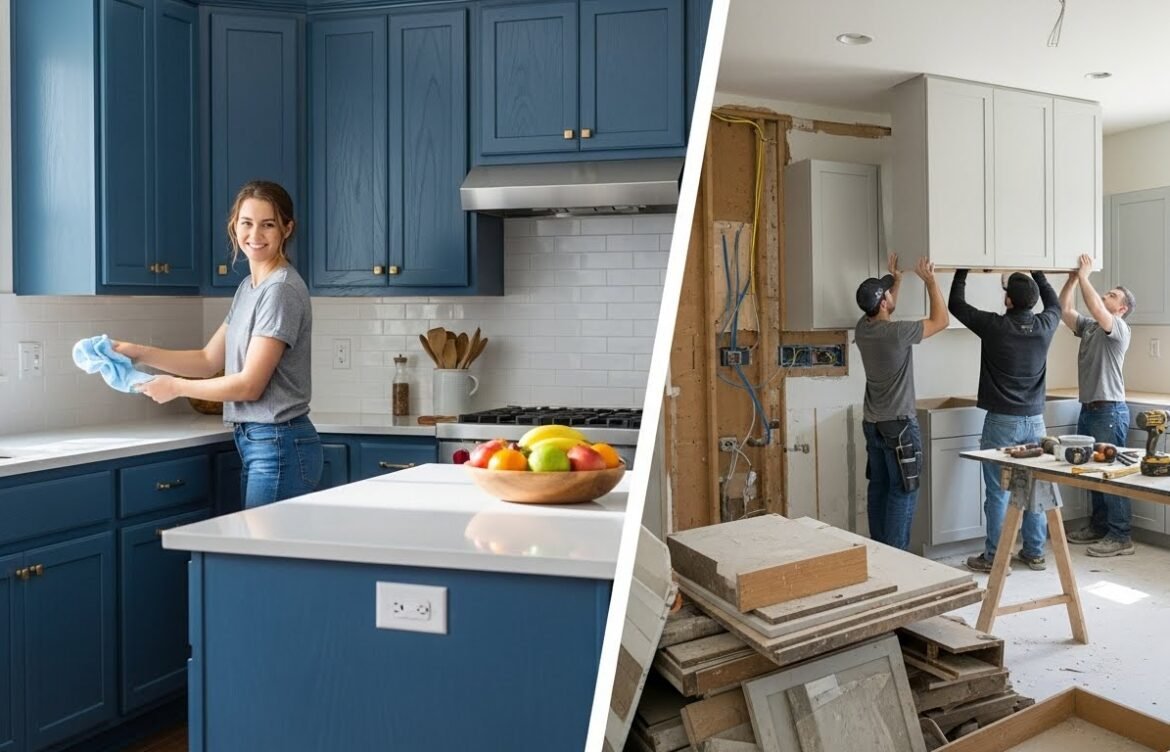
Kitchen Cabinet Refinishing vs. Replacement: The Real Cost Breakdown
You know that moment. You walk into your kitchen to grab a coffee, the morning light hits the cabinets just right, and you suddenly realize… you hate them.
Maybe they’re that honey-oak color from 1998. Maybe the finish is worn down around the handles. Or maybe you just feel like your kitchen is tired.
So, you do what we all do. You start Pinterest-ing. You dream of a full tear-out, brand new shaker cabinets, maybe moving the sink to the island. Then, you call a contractor for a quote.
And then you fall out of your chair.
Look, I’ve seen this happen a hundred times. A homeowner expects a kitchen refresh to cost a few thousand dollars, and the quote comes back looking like the down payment on a second house. It’s discouraging. But here’s the thing: you usually don’t need to rip everything out to get the kitchen you want.
Let’s talk honestly about the math behind professional cabinet refinishing versus a total replacement. Because the difference in price isn’t just “a little bit.” It’s astronomical.
Why Is Replacement So Expensive? (The Hidden Costs)
When you look at the price of a single cabinet box at a big box store, you might think, “Okay, $200 a cabinet, I have 15 cabinets… that’s only $3,000.”
If only it worked that way.
Replacing cabinets is a domino effect. It’s never just the cabinets. Once you rip those boxes off the wall, you open Pandora’s box.
- The Demolition: You have to pay someone to rip out the old ones and haul them away.
- The Countertops: It is incredibly difficult to remove base cabinets without destroying your countertops. So, add another $3,000 to $8,000 for new stone or quartz.
- The Plumbing & Electrical: The sink has to come out. The dishwasher has to be disconnected. The outlets might need to move. Suddenly, you’re paying a plumber and an electrician hourly rates.
- The Floors: Often, the flooring doesn’t run underneath the old cabinets. If the new footprint is even an inch different, you’re now re-doing the floors, too.
Before you know it, a “kitchen update” is a $35,000 to $50,000 renovation project that takes six weeks to finish. Living without a kitchen sink for six weeks? That’s rough.
The Alternative: Working With What You Have
Here is the secret the custom cabinet industry doesn’t really emphasize: Most older cabinets are actually built better than the new stuff.
If your home was built twenty or thirty years ago, your cabinet boxes are likely solid wood or high-grade plywood. New “stock” cabinets today? They’re often particle board held together with glue and staples.
If you like the general layout of your kitchen—meaning the fridge, sink, and stove are in spots that make sense—there is almost zero reason to pay for a demolition crew.
This is where professional refinishing (or painting) changes the game. You keep the solid structure, the countertops stay safe, and the plumbing stays hooked up. You’re purely changing the aesthetic skin of the room.
And that’s where the savings come from. You aren’t paying for materials and demolition; you’re paying for labor and skill.
The Numbers: Refinishing vs. Replacement
Let’s get down to brass tacks.
While prices vary depending on where you live and the size of your kitchen, the ratio usually stays the same. Refinishing typically costs about 20% to 30% of the cost of replacement.
If a full replacement (including new counters and labor) is quoted at $30,000, a high-end, professional refinishing job might clock in around $4,000 to $7,000.
That is a savings of over $20,000. That’s a car. That’s a college tuition payment. That’s a dream vacation.
But—and this is a big “but”—I’m talking about professional cabinet refinishing. I’m not talking about slapping a coat of wall paint on your doors and hoping for the best.
What You actually Pay For with Refinishing
When you hire pros, you aren’t just paying for someone to hold a brush. You’re paying for:
- De-greasing: Years of cooking oils make cabinets invisible nightmares for paint adhesion. They have to be chemically cleaned.
- Sanding & Bonding: The surface has to be prepped so the new finish doesn’t peel off in six months.
- Spraying: Brush marks look amateur on cabinets. You want that factory-smooth finish that only comes from professional sprayers.
- Durability: Using industrial-grade coatings (like 2K polys or urethanes) that resist chipping.
5 Actionable Tips Before You Decide
If you’re sitting on the fence, trying to decide if your cabinets are candidates for refinishing, run through this mental checklist.
1. Check the “Bones”
Open your cabinet doors. Are the frames solid? Do the drawers slide reasonably well (even if the hardware needs updating)? If the structure is sound, keep them. If the wood is rotting or water-damaged, you might need replacement.
2. Ignore the Grain
A lot of people hate their oak cabinets because of the heavy grain texture. Don’t let that stop you. Professional painters know how to paint oak cabinets specifically to minimize that grain and give you a smooth, modern look. You aren’t stuck with the texture just because you keep the wood.
3. Hardware Changes Everything
You can save thousands by refinishing, but you can make them look like a million bucks by swapping out the handles and knobs. Filling old holes and drilling new ones for modern hardware is a standard part of the refinishing prep process.
4. Think About ROI
Are you selling soon? Kitchens sell houses. But you rarely get a 100% return on investment for a $50k remodel. However, spending a fraction of that on interior painting and cabinet refinishing yields a massive return because the kitchen looks brand new for a minimal cost.
5. Verify the Process
If you decide to hire someone, ask them specifically about their process. If they say they’re going to “brush and roll” your cabinets using standard latex paint, run away. You want a team that treats your kitchen like a furniture factory, not a drywall project.
How We Handle This
I wanted to mention how we view this at Precision Paint Experts. We’ve walked into countless homes where the owners felt trapped by their outdated kitchens. They thought they had to live with it because they couldn’t afford a remodel.
seeing the look on a homeowner’s face when we take down the masking tape is pretty amazing. They usually say something like, “I can’t believe these are the same cabinets.”
We focus on using coatings that are hard enough to withstand fingernails, dog tails, and slamming doors. Because a kitchen isn’t a museum; it’s a workspace. It needs to hold up.
FAQ: Common Questions on Refinishing
How long does refinishing take compared to replacement? Replacement can take 4-8 weeks (or more if materials are back-ordered). Professional refinishing usually takes 5 to 7 days. And you can usually keep using your kitchen for most of that time.
Will the paint chip? If you use standard wall paint? Yes. If you use professional industrial wood coatings? No. It should be as durable as a factory finish.
Can I just replace the doors and paint the boxes? You can! This is called “refacing.” It’s more expensive than refinishing but cheaper than full replacement. However, if your current doors are a simple style (like flat panel or shaker), refinishing them is usually the better value.
The Bottom Line
Your home should make you happy. But you shouldn’t have to empty your savings account to get that feeling.
If your cabinets are falling off the wall, replace them. But if they’re just ugly? Save your money. Refinish them. Use that extra $20,000 for something you’ll actually enjoy—like a trip to Europe, or hey, just padding that savings account.
If you’re curious about what the numbers would look like for your specific kitchen, we’re happy to take a look. No pressure, just honest advice. You can get a free quote here, and we can chat about what’s possible for your space.